Loading
Improving safety of hydraulic systems by using hose restraints

Subscribe by Email

Your email:

Follow Us

All Blogs

Contact Us

 
888.715.4673
 
PRIVACY POLICY:

See the link in the page footer. We do not share any of our customers' information with outside parties except as required by law.
 
* Required field

Blog - Hose & Fittings, Etc.

Current Articles | RSS Feed RSS Feed

Improving safety of hydraulic systems by using hose restraints


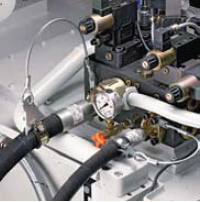
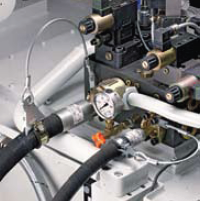
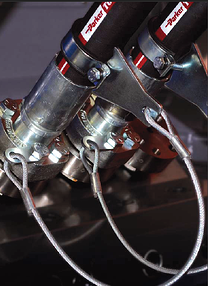
Hose Restraint System in action

If you worked around hydraulic systems for any length of time, you have seen a hydraulic hose failure. Whether the failure is caused by a hose being snagged by a moving part or the hose blows off a fitting, the consequences can be more than just a big mess and loss of hydraulic oil. One such consequence is a hose whip.
Hose Whip Prevention System InstalledWhen a hose assembly completely fails at a point close to a fitting, the pressure in the hose causes it to thrash around. It can hit and damage other components of the hydraulic systems and injure personnel. 
One solution to guard against an eventual hose whip is to use a hose restraint system. Hose restraint systems are designed to prevent whipping of a pressurized hose in the event of a hose separating from its fitting.  They provide an additional level of safety and help prevent damage to nearby equipment or injury to operators near the failed hose by limiting the distance of travel of the pressurized hose after it breaks free from the fitting.
The system is comprised of two components, a hose collar and a cable assembly. The hose collar is selected based on the outside diameter of the hose, and the cable assembly is selected based on the type of hose connection.

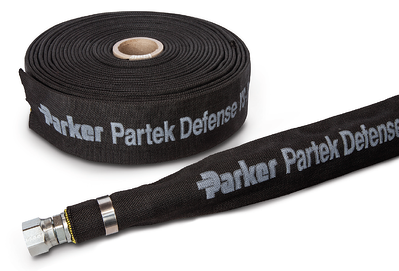
One of the Hose Whip Prevention systems is manufactured by Parker. Parker hose whip prevention systemParker offers two types of cable assemblies – one for flange-type connections, and the other for port adapters.
The hose whip restraint is not to be used in place of proper hose crimping procedures.  The Parker hose whip restraint system has been tested to work at operating pressures of the hoses it is designed to work with. It is not meant to increase the hoses working pressure or to add incremental pressure rating to the hose / fitting combination. Your hose-fitting-whip restraint system is rated to the pressure of the lowest rated component of the system.

Posted by Joni Scott
© Hose & Fittings, Etc.
Tags: 

Comments

Is using these restraints a current requirement by OSHA? Can you send me to the link?
Posted @ Tuesday, October 18, 2011 8:08 AM by Cori Ritchie
Thanks for the question, Cori. I am not an expert on OSHA compliance but it seems unlikely that they would require you to use a particular product. Here is a link to their website: http://www.osha.gov/pls/oshaweb/owasrch.search_form?p_doc_type=STANDARDS&p_toc_level=1&p_keyvalue=1910 
The section 1910 (it has numerous sub-parts) lists different requirements, some general (like requirements for walking surfaces and fire exit availability) and some more focused on industries or types of machinery. I am not sure what situation applies to you but hopefully this will point you in the right direction.  
Best of luck with your project! 
Marek Bobik 
Posted @ Tuesday, October 18, 2011 11:40 AM by Marek Bobik
How do I find part numbers for ordering?
Posted @ Tuesday, November 22, 2011 4:48 PM by Benjamin Hall
Thank you for the question Benjamin. You can find the part numbers on the Hose Whip Restraint product page. To get the right parts, be sure to have the correct outside diameter for your hose and either adapters or flange connectors you are using. 
 
Please do not hesitate to call us with more questions at 888.715.4673, email us at hfe@hfeweb.com or fill out any form you see on our website. 
 
Hope this helps – thanks again! 
 
Marek Bobik 
 
Posted @ Tuesday, November 22, 2011 7:35 PM by Marek Bobik
Post Comment
Name
 *
Email
 *
Website (optional)
Comment
 *

Allowed tags: <a> link, <b> bold, <i> italics

Posts by Month